by Biljana Purić
This diary entry, started a few days after the largest rally in the Serbian capital, initially focused exclusively on the events of March 15th. However, over time, it expanded to include subsequent developments, though I was reluctant to alter the title—since it seems, at least to me, that this day, along with the past five months of protests across the country, has merged into one continuous event: its trajectory unfolding not so much through time as across geographies. I have tried to convey this somewhat contradictory perspective here, drawing on both the affective and analytical dimensions of what I have experienced and read about since. The legacy of March 15th continues to shape the political and social circumstances presently unfolding in Serbia and elsewhere, with analysts trying to gauge the student-led actions’ impact and political significance. I took these perspectives into consideration and sought to evaluate the urgency for immediate results within a broader scheme of things.
Saturday, March 15th, 2025, began both similarly to and differently from other Saturdays in Belgrade. People still went shopping at farmers’ markets, visited their favourite bread and coffee shops, but there was also a noise in the air—a humming of sounds from near and afar, revealing that the situation was extraordinary. The sound reminded me of a beehive—a pleasant buzzing pierced from time to time with sharp sounds of horns and whistles. The student-organized rally in Serbia’s capital was set for 4 p.m., but from the sounds, it seemed that everyone was eager to get to the city centre as soon as possible.
As I made my way home from the Kalenić market, I had to navigate through a river of people—families, children, even pets—pouring in from all directions toward King Aleksandar Boulevard, all heading downtown. Some carried national flags; others held placards and protest signs, most with whistles around their necks and smiles on their faces. The positive energy was palpable.
The rally was part of a sustained wave of student-led actions that had begun almost four month earlier, sparked by a horrific tragedy on November 1st, 2024, in which 16 people lost their lives when a concrete canopy of the recently renovated Novi Sad railway station collapsed. The investigation into the collapse was delayed, non-transparent, and riddled with inefficiencies, prompting students to call for accountability. After peaceful protesters demanding an investigation into the corruption that led to the disaster were brutally attacked outside the Faculty of Dramatic Arts in Belgrade, students organized nationwide university blockades and staged rallies across the country. The practice of 16-minute traffic blockades to honour the victims also continued in cities across Serbia.
The students’ demands, 6 in all, of which two were added after March 15th,[1] were not initially aimed at removing the government. The students explicitly stated that they were not calling for regime change but for institutions to start acting in accordance with the law; however, this changed on May 5th, when student plenums announced a new demand for early parliamentary elections, following the regime’s failure to fulfil their initial demands. Rooted in non-violence, solidarity, and self-organization, the plenums represent a viable alternative to representative democracy on the micro level. Students also proposed broader public engagement through zbor, a form of public assembly where citizens could deliberate and vote on local issues in their municipalities. Both plenums and zbor, regardless of their democratic outlook, provoked criticism from all sides of the political spectrum.
The usual conservative backlash aimed at any echo of Yugoslav-era social organization or leftist ideas was accompanied by voices that reject ideas of direct democracy as inefficient, utopian, or legally dubious.[2] Recent rumours suggest that the plenums are also internally divided between those favouring direct democracy, and those preferring Western, neoliberal democratic procedures. However, an outsider’s view of the plenums may not be entirely accurate (the plenums are only open to students and those who students invite).
As Marko Miletić explains, progressive ideas are already at the root of the movement, and current attempts to weed out ideological differences within the student movement reflect a reactionary politics, one that is unaware of the movement’s core leftist values. [3] These values are, as Saša Savanović notes, essentially feminist.[4] The unity between students and citizens, a broad class alliance against the local comprador bourgeoisie entrenched in corruption and set on selling the country’s remaining assets, including protected cultural monuments, which undoubtedly crosses ideological lines, is based in “an ethics of care—for the different, the vulnerable, the oppressed, the invisible, and the forgotten. It values life (not only human life), insists on nonviolence, solidarity, and concern for the common good. It is anti-fascist because it cares about the well-being of others; anti-colonial and anti-imperialist because it rejects the logic of superiority of some over others; and it is undoubtedly class-conscious, refusing to accept the ‘naturalness’ of appropriation and exploitation.”[5] Most recently, Dejan Ilić criticized these reactionary tendencies, calling for more critical, yet constructive, engagement with the student movement: supportive, but not beyond critique.[6] While this discourse gains momentum, the broad front of different ideological and political options already stood together on March 15th.
I continue this piece with several images:
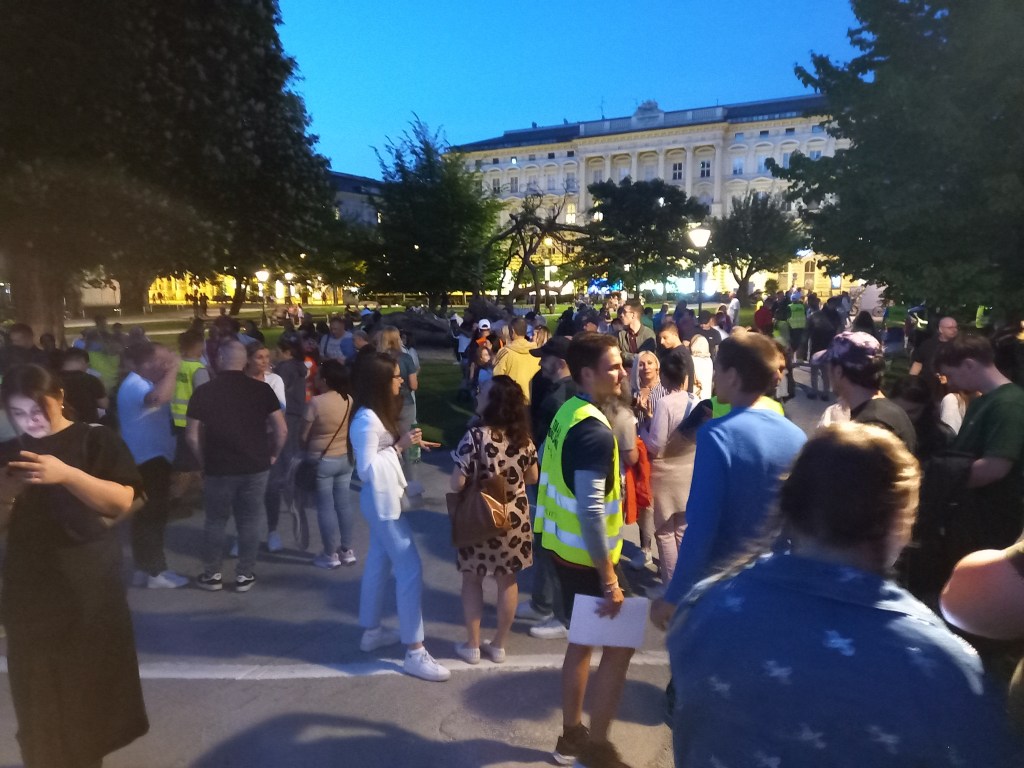
A sea of people on King Aleksandar Boulevard, where my companions and I joined the crowd, slowly progressing toward the main square. People gathered in front of the Faculty of Architecture, cooking, playing music, and preparing their props. A replica of The Victor statue from Kalemegdan Fortress looming over us. Playful and satirical protest signs offering levity in an otherwise urgent atmosphere.
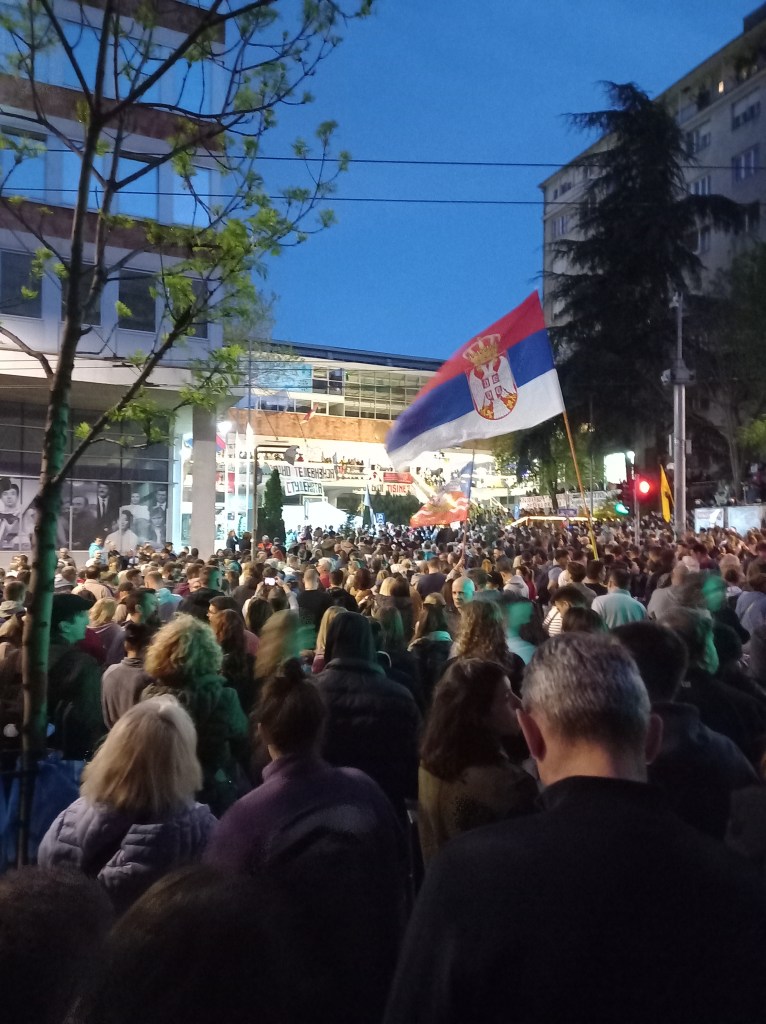
Then the unsettling contrast: the infamous Ćaciland[7], the area of the Pioneer park, barricaded with two rows of tire-deflated trucks, in front of the President’s residence Novi Dvor, where throws of men dressed in black and with balaclavas on their heads were hoarded in the night before, to join the group of the so-called ‘students 2.0’— a regime-installed group largely composed of older individuals, local officials, and members of the disbanded notorious Red Berets unit aligned with the ruling party. ‘Orcs rounded in Mordor,’ as one social media post quipped, all with identical backpacks and umbrellas, undermining any claim to spontaneity. The destroyed park turned into a muddy mush and filled with camping tents. Police and special forces in full gear. Who would they protect if the violence the President Aleksandar Vučić warned about erupted? The feeling was—it wouldn’t be us.

The commemorative 15-minute[8] silence was scheduled for 7 p.m. After a spontaneous techno party at the corner of Ilije Garašanina and Majora Ilića streets, we headed toward the Parliament, but student stewards redirected us to Slavija Square due to security closures. We joined the crowd on Terazije and paused at Cvetni trg near the Student Cultural Centre, when the silence began. We set the lights on our phones on and pointed them towards the sky, as was customary in these occasions, when people collectively mourned and remembered Novi Sad victims. Suddenly, several hundreds of thousand people fell so silent that the buzzing of drones above us became clearly audible, along with coughs, and rustling of jackets. Officially, the rally was to end at 8 p.m.
Just a few minutes before the silence was to conclude, a loud sound of rushing vehicles erupted behind us, and I instinctively turned to see what was going on, in cold realization that something is approaching in high speed to crush us. People started parting in panic along the middle of the road, running left and right for cover, some fell, screams echoed. It lasted no longer than 10-15 seconds. Shaken, heart pounding, I stood by the curb, unsure of what had just happened. Others looked equally stunned, checking on one another. Then came the sound of cannon-blast firecrackers—thrown, we later learned, from a nearby construction site by hooligans. As we moved slowly up the street, people from Slavija Square poured down towards us. The rally was over.

What happened in those seconds when the silence was so violently interrupted became the main topic in the following days. The government was accused of using some sort of a sonic weapon against peaceful protesters; the regime’s defence, both aggressive and inept, revealed once again the gaping emptiness in the state structures where independent institutions should be. From police and judiciary to the president himself, all rushed to deny anything had happened. In one of his many addresses before the official investigation even begun, the president stated that it would be concluded in 48 hours. And, so it was. Even reports of health issues following the alleged sonic strike were dismissed as false.
In the following days and weeks, the crisis in the country intensified. Protesters blockaded the national public broadcaster RTS for several weeks over its consistent failure to report objectively on the protests, and students joined forces with workers and unions in a May Day demonstrations. A particularly cathartic moment came when a protest in Novi Pazar showed images of unity between the Muslim minority and other citizens, defying the often-imposed nationalist and ethnic divisions from the past. The response from the regime also escalated. Some protestors were imprisoned for allegedly plotting a coup, others experienced police brutality, while professors and teachers faced salary cuts. Despite Serbia’s stated EU ambitions, EU institutions remained largely silent.
A few days after March 15th, President Vučić met with European Enlargement Commissioner Marta Kos. She described the meeting as “constructive,” offering no comment on the ongoing repression. Soon after, European Commission President Ursula von der Leyen met Vučić as well, ignoring MEPs’ calls to cancel. These events, coupled with the EU’s ongoing support for lithium mining in Western Serbia, which experts warn will cause a massive ecological disaster, have only deepened public disillusionment with the EU. By backing stabilocracy over democracy, and in light of these most recent failures, it is not surprising that students and citizens in Serbia are turning toward plenums and other self-organizing formats rooted in past legacies. It seems that the present neoliberalism and democracy are increasingly at odds, if ever they were compatible. In Serbia, North Macedonia, where a horrendous tragedy struck just a day after the rally in Serbia, and with the uprising in Turkey, people are taking to the streets, demanding justice, organizing against the state machinery, and imagining alternatives.
Following March 15th, I participated in several assemblies (zbor) in my municipality. While the focus never diverged from broader questions of how we, as neighbours and colleagues, could support the student and citizen movement, we also discussed how to effectively improve local conditions—from stopping the deforestation of the nearby forest to challenging non-transparent urban development projects. This led to several initiatives that are currently unfolding, some of which are already producing results. What I find even more important is the renewed sense of community, the strengthening of individual political agency and involvement in decision-making, which had been lacking in the past, and the regional network of support among protest movements that became visible.
Perhaps these demonstrations of direct democracy signal a larger shift—one that the EU and others should pay close attention to. If the former Yugoslav region once served as the “dark avant-garde” of global trends[9] (a warning proven true time and again), then perhaps these current events could foreshadow a broader change that is about to happen. Beyond analyses focused solely on protests, a broader and bolder approach is needed that attends to moments of change and transformation that occur beyond them.
After over a decade of the current regime, public impatience is high, and the demand for immediate changes is strong. Yet, they may not come quickly. Instead of searching for immediate results of the protests, one may refer to its broader, long-term impact. As Papadopoulos, Stephenson, and Tsianos write, “to pin our hopes on events is a nominalist move which draws on the masculinist luxury of having the power both to name things and to wait about for salvation.”[10] What they ask instead is to cultivate a sensibility to note moments that are not yet named.
In the face of entrenched corruption and Western complicity, people continue fighting, protesting, and experimenting with alternative social models. It is worth questioning whether democracy, as delivered by the EU, holds any relevance for those on the ground—those who wish to decide their futures on their own terms. In a context where elections are easily rigged, as repeatedly witnessed in Serbia, direct democracy emerges not just as a theoretical ideal, but as a lived necessity: one where communities across municipalities deliberate and decide on political and social issues themselves. Change may not be immediate. But the processes and grassroots initiatives now unfolding offer a chance to cultivate sustained political engagement that redefines what democracy could mean in everyday life.
As I conclude this entry, the protests continue. A group of 80 students cycled to Strasbourg, to raise the awareness of the current situation in Serbia in front of the EU representatives. We also welcomed another group of students who are running to Brussels in Salzburg a few nights ago, in hope of further alerting the EU. Seeing these actions and following the muted responses from EU officials, one cannot help but wonder if this is not also a call for the EU to finally face its inadequacy, its failure of democratic ideals, and to stand responsible in front of the problems it engenders. From Serbia, but also from other parts of the region and the world, including Turkey, Greece, North Macedonia, and Palestine, the message is clear. Will an adequate response finally arrive?
[1] The demands include the release of the complete documentation related to the reconstruction of the Novi Sad railway station; the withdrawal of criminal charges against students arrested and detained during the protests, as well as the suspension of ongoing criminal proceedings; the identification and prosecution of those who attacked students and professors; a 20% increase in government funding for university-level education; an investigation into the sonic attack on protesters on March 15th; and an investigation into those responsible for allowing President Aleksandar Vučić and journalists to enter the intensive care unit of the Clinical Center of Serbia, where victims of the fire in Kočani are being treated.
[2] Stevan Filipović, Prvi maj, zborovi, i Crveni Kmeri, Peščanik, 3. May 2025. https://pescanik.net/prvi-maj-zborovi-i-crveni-kmeri/
[3] Marko Miletić, Budite ponosni – to vam je vasa borba dala, Mašina, 6.5.2025. https://www.masina.rs/budite-ponosni-to-vam-je-vasa-borba-dala/
[4] Saša Savanović, Kako nakon 15. marta: O čemu govorimo kada govorimo o promeni sistema, Mašina, 17. March 2025. https://www.masina.rs/kako-nakon-15-marta-o-cemu-govorimo-kada-govorimo-o-promeni-sistema/
[5] Ibid.
[6] Dejan Ilić, Verujem opoziciji, Peščanik, 9. May 2025. https://pescanik.net/verujem-opoziciji/
[7] The term ćaci originates from a misspelled message spray-painted—presumably by a regime sympathizer—on a school wall in Novi Sad, urging pupils to return to schools. The graffiti read “ćaci u škole” (ћаци у школу), where the letter ć (ћ) was incorrectly used instead of đ (ђ), the proper letter for the word pupils (đaci / ђаци). The term quickly became symbolic of regime supporters, connoting illiteracy or a lack of education. In an effort to neutralize or reclaim the term, it was later embraced by government officials. T-shirts bearing the slogan “I ja sam ćaci” (“I too am ćaci”) were printed and worn, including by the President himself, in a fumbling attempt at defiance.
[8] The 16th victim of the canopy collapse died after March 15th.
[9] Davor Konjikušić, “Milica Tomić: Bili Smo Tamna Avangarda Globalnih Promena,” Novosti, February 5, 2017, https://www.portalnovosti.com/milica-tomic-bili-smo-tamna-avangarda-globalnih-promena.
[10] D. Papadopoulos, N. Stephenson, and V. Tsianos, Escape Routes: Control and Subversion in the 21st Century, Pluto Press, 2008.
Biljana Purić is a doctoral researcher at the University of Graz. Her research focuses on contemporary art and politics and art practices emerging from the post-Yugoslav region. She has published articles as well as art and film reviews and criticism in ARTMargins, Issues in Ethnology & Anthropology, Third Text, Loophole Magazine, The Journal of Curatorial Studies, and Short Film Studies.
 Globalising Southeastern Europe
Leave a comment